

OPC UA interface: your PLC data for databases, MES and analytics
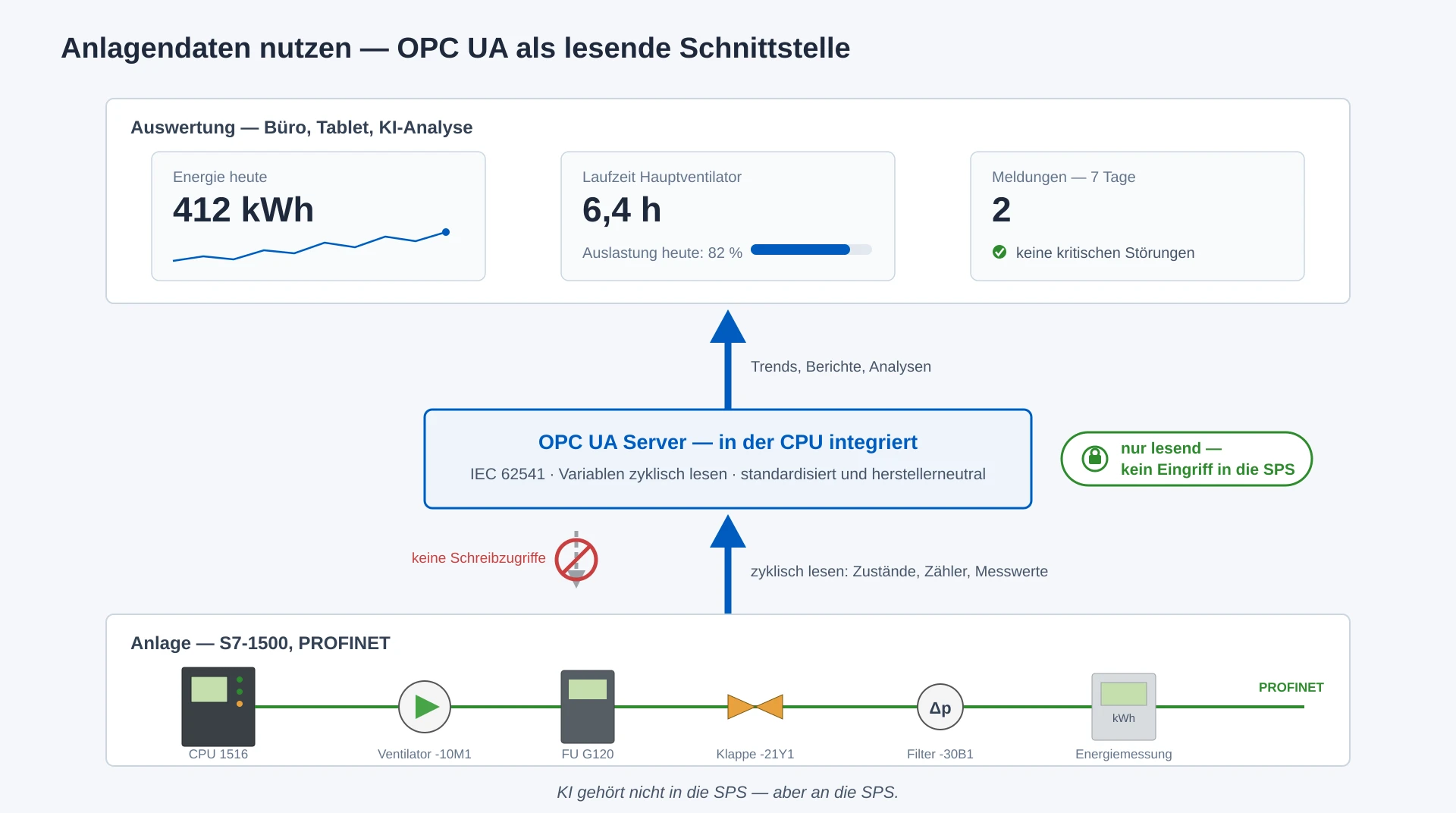
We set up the S7-1500 as an OPC UA server and take the plant data where it is needed: into a database, into MES or ERP, or via MQTT into your IT. Read-only, so the controller keeps running its logic undisturbed.
- international industrial standard
- IEC 62541
- analysis without intervening in the controller
- Read-only
- uses data the PLC captures anyway
- 0 new sensors
In short
An OPC UA interface makes the data of a Siemens controller readable for databases, MES, ERP and analytics, standardized to IEC 62541. To that end, we set up the S7-1500 as an OPC UA server: we define which tags are visible from outside, secure the connection and link the data to your systems via OPC UA, MQTT or a database. The control logic itself stays untouched.
OPC UA on the S7-1500
The S7-1500 comes with the OPC UA server as standard, and the S7-1200 also offers an OPC UA server in current firmware versions. This gives your plant a standardized data interface to IEC 62541 — encrypted, with role-based access rights, usable purely read-only. What matters in practice:
- Deliberate exposure: we publish only the tags that are needed outside, cleanly named and structured — instead of exposing entire data blocks.
- Read and write kept apart: write access exists only where it is functionally intended and secured. Analytics only need read access.
- Security: encrypted connection with certificates and user authentication, unsecured endpoints switched off.
- License and load: the S7-1500 OPC UA server requires a runtime license matching the CPU. We size the scope and sampling rate so the controller keeps its cycle time.
- Older controllers: an S7-300/400 is read via S7 communication or a gateway. In the long run, a retrofit to the S7-1500 is the cleaner solution.
The door the retrofit opens
An S5 or S7-300 simply does not have this interface. With the new controller, external analysis systems can read off the plant data while the controller itself runs its deterministic logic untouched.
From PLC to database
The PLC does not write to the database itself. A lightweight service reads the values via OPC UA, buffers them and writes them to an SQL or time-series database. The controller stays free of database logic, and short network interruptions are bridged.
- Typical targets: Microsoft SQL Server, PostgreSQL or a time-series database for measured values.
- Events, not a constant stream: alarms, state changes and counters are written when they change, measured values at a suitable interval.
- Context included: order, batch or shift belong in the record, so values can be traced later.
- MES and ERP: connected directly via OPC UA, through the database or through the interface your IT specifies.
MQTT: distributing data to IT and cloud
OPC UA is strong for the direct link between controller and supervisory level. When many systems need the same data, MQTT is often the simpler choice: a broker distributes the values, and each consumer subscribes only to what it needs.
- From the S7-1500 directly via an MQTT client block, or via a gateway that reads the values over OPC UA and passes them to the broker.
- Node-RED as a bridge: for manageable integrations, protocol conversion and quick prototypes, with a clear line on what stays in the PLC.
- A clean topic structure and an encrypted connection to the broker, agreed with your IT.
What is realistically feasible today
Without corporate IT and without additional sensors — from the data the PLC captures anyway:
- Alarm and fault analysis: which sensor reports most often? Which fault recurs every week?
- Downtime reports: automatically from the operating states the controller knows.
- Plain-text reports instead of raw data: readable shift or weekly reports from structured process data.
- Energy monitoring: consumption and peak loads per plant section, deviations as an early indicator.
- Early warning: motor currents, run times and cycle times as a wear indicator, long before a person notices in day-to-day operations.
Analytics, reporting and dashboards on top
Once the data is flowing, we build the analytics for you, developed with AI assistance and tailored to your plant rather than standard software your plant has to adapt to:
- Dashboards: plant status, faults and downtime at a glance, in the browser.
- Reporting: shift, daily and weekly reports generated automatically from the recorded data.
- Data capture and shift schedules: production data linked to shift, order or batch.
- Edge instead of cloud, if preferred: analytics on a computer in your network, the data stays on site.
A sober view
The benefit lies in visibility and faster diagnosis — not in a “self-healing plant”; no one should believe such promises. None of this has to be live on the changeover day: the retrofit unlocks the door, and you can use it whenever you are ready.
AI discipline
AI reads the PLC's data via OPC UA and analyzes it outside the controller. No AI runs in the controller itself: the PLC works with deterministic, tested logic, and the analysis does not write into the process. This separation is the condition under which AI can be used responsibly in a machine environment.
Frequently Asked Questions
What is an OPC UA interface?
A standardized data interface to IEC 62541 through which controllers, SCADA systems, MES and databases exchange data independently of the manufacturer. Values are available in a structured form with name, data type and access rights, not as raw memory addresses.
Can the S7-1500 act as an OPC UA server?
Yes. The OPC UA server is integrated into S7-1500 CPUs and is activated and configured in TIA Portal; operation requires a runtime license matching the CPU. We define for each tag whether it is visible and whether it is read-only or also writable.
Is this AI in my controller?
No. The PLC runs its deterministic, tested logic unchanged — exactly as safety and standards require. Analysis systems read the data off via OPC UA read-only; no model writes into the process.
Do I need new sensors for this?
Usually not. Motor currents, run times, cycle times, messages and operating states are captured by the controller anyway — and exactly this data is already enough for fault analysis, reports and early warning.
How secure is the interface?
OPC UA is the international standard IEC 62541 — with encryption and role-based access rights. You can define exactly who may read which data; the connection stays within the plant or company network.
How does PLC data get into a database?
Through a service between controller and database that reads the values via OPC UA or MQTT and writes them to the database, for example SQL Server, PostgreSQL or a time-series database. The PLC stays free of database logic. We plan data points, intervals and buffering so the data can be analyzed later.
OPC UA or MQTT: which fits better?
It depends on the goal. OPC UA suits the direct, structured connection to the controller, for example for MES or SCADA. MQTT has the edge when many consumers need the same data or the data goes into IT and cloud systems. We often combine both: OPC UA at the controller, MQTT for distribution.
Unlock your plant data
From the first downtime report to energy monitoring — beginning with the data your plant already has today.
✓ Non-binding initial consultation✓ Response time < 24h on business days